Produktbeskrivning
Customizations to products
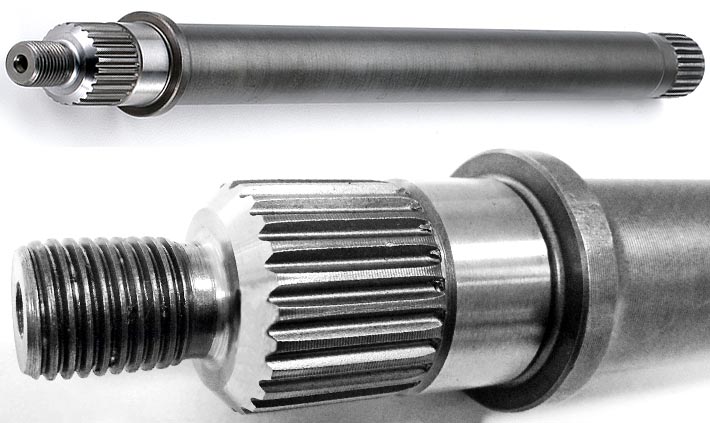
| specification | |||||||
| WAI No | No Of Teeth | Rotation | Length(mm) | Pinion O.D.(mm) | No OF Splines | Pinion I.D.(mm) | Drive O.D.(mm) |
| 6/12 | CW | 126 | 14 | 12 | |||
| 6/12 | CW | 117 | 14 | 10 | |||
| Punkt | Spiral kugghjulsaxel |
| Material | 4140, 4340, 40Cr, 42Crmo, 42Crmo4 |
| OEM-nr | Anpassa |
| Certifiering | ISO/TS16949 |
| Testkrav | Magnetiskt pulvertest, hårdhetstest, dimensionstest |
| Färg | Färg, naturlig finish, bearbetning runtom |
| Material | Aluminium: 5000-serien (5052…)/6000-serien (6061…)/7000-serien (7075…) |
| Stål: Kolstål, mellanstål, stållegering etc. | |
| Rostfritt stål: 303/304/316, etc. | |
| Koppar/mässing/brons/röd koppar, etc. | |
| Plast: ABS, PP, PC, nylon, Delrin (POM), bakelit, etc. | |
| Storlek | Enligt kundens ritning eller prover |
| Behandla | CNC-bearbetning, svarvning, fräsning, stansning, slipning, svetsning, trådinjektion, skärning etc. |
| Tolerans | ≥+/-0,03 mm |
| Ytbehandling | (Sandblästring) och (hård) och (färg) anodisering, (krom, nickel, zink…) plätering, målning, pulverlackering, polering, svärtning, härdning, laserskärning, gravyr etc. |
| Filformat | ProE,SolidWorks,UG,CAD,PDF(IGS,XT,STP,STL) |
| Prov | Tillgänglig |
| Förpackning | Spline protect cover ,Wood box ,Waterproof membrane; Or per customers’ requirements. |
Sample service
Vi tillhandahåller gratis prov för bekräftelse och kunden bär fraktkostnaderna
OEM-tjänst
Med vår egen fabrik och professionella tekniker välkomnar vi även OEM-beställningar. Vi kan designa och producera den specifika produkt du behöver enligt din detaljerade information.
After-sale Service
Our enthusiastic and friendly customer service representatives are ready to assist with any questions or problems
| Material: | Legerat stål |
|---|---|
| Ladda: | Drivaxel |
| Axelform: | Rak axel |
| Utseende Form: | Runda |
| Pinion O.D.(mm): | 14 |
| Avkastning: | 5 000 st / månad |
| Prover: |
US$ 0/Styck
1 styck (minsta beställning) | |
|---|
| Anpassning: |
Tillgänglig
| Anpassad förfrågan |
|---|
Hur hanterar splineaxlar variationer i vridmoment och rotationskraft?
Splineaxlar är konstruerade för att hantera variationer i vridmoment och rotationskraft i mekaniska system. Här är en detaljerad förklaring:
1. Sammankopplade splines:
Splineaxlar har en serie sammankopplade splines längs sin längd. Dessa splines griper in i motsvarande splines på motstående komponenter, såsom kugghjul eller kopplingar. Den sammankopplade designen säkerställer en säker och robust anslutning, som kan överföra vridmoment och rotationskraft.
2. Lastfördelning:
När vridmoment appliceras på en splineaxel fördelas lasten över hela splines ingreppsytan. Detta bidrar till att minimera spänningskoncentrationer och förhindrar lokalt slitage eller fel. Splineaxlarnas lastfördelningsförmåga gör att de effektivt kan hantera variationer i vridmoment och rotationskraft.
3. Materialval:
Splineaxlar tillverkas vanligtvis av material med hög hållfasthet och hållbarhet, såsom legerat stål. Materialvalet är avgörande för att hantera variationer i vridmoment och rotationskraft. Det säkerställer att splineaxeln kan motstå de applicerade belastningarna utan deformation eller fel.
4. Splineprofil:
Splineprofilens utformning bidrar också till hanteringen av vridmomentvariationer. Splineprofilen bestämmer kontaktytan och kraftfördelningen längs splines. Genom att optimera splineprofilen kan tillverkare förbättra lastbärande kapacitet och förbättra splineaxelns förmåga att hantera variationer i vridmoment.
5. Ytbehandling och smörjning:
Korrekt ytfinish och smörjning spelar en avgörande roll för splineaxlars prestanda. En slät ytfinish minskar friktion och slitage, medan lämplig smörjning minimerar värmeutveckling och säkerställer smidig drift. Dessa faktorer hjälper till att hantera variationer i vridmoment och rotationskraft genom att minska friktionens och slitagets inverkan på splinesingreppet.
6. Designöverväganden:
Ingenjörer tar hänsyn till flera designaspekter för att säkerställa att splineaxlar kan hantera variationer i vridmoment och rotationskraft. Dessa överväganden inkluderar lämpliga splinedimensioner, kuggprofilgeometri, splinepassningstolerans och val av anslutningskomponenter. Genom att noggrant utforma splineaxeln och dess anslutningskomponenter kan ingenjörer optimera systemets prestanda och tillförlitlighet.
7. Överbelastningsskydd:
I vissa tillämpningar kan splineaxlar vara utrustade med överbelastningsskyddsmekanismer. Dessa mekanismer, såsom brytstift eller momentbegränsare, är utformade för att tillfälligt koppla bort drivningen eller slira när vridmomentet överstiger ett visst tröskelvärde. Detta skyddar splineaxeln och andra komponenter från skador på grund av för högt vridmoment.
Sammantaget hanterar splineaxlar variationer i vridmoment och rotationskraft genom sina sammankopplade splines, lastfördelningsförmåga, lämpligt materialval, optimerade splineprofiler, ytfinish, smörjning, designöverväganden och, i vissa fall, överbelastningsskyddsmekanismer. Dessa funktioner säkerställer effektiv momentöverföring och gör att splineaxlar kan motstå kraven från olika mekaniska system.
How do spline shafts handle variations in environmental conditions?
Spline shafts are designed to handle variations in environmental conditions and maintain their performance and reliability. Here’s a detailed explanation:
1. Temperature Variations:
Spline shafts are engineered to withstand a wide range of temperature variations. They are constructed from materials that exhibit good thermal stability, such as high-grade steels or alloys. These materials have low coefficients of thermal expansion, minimizing the effects of temperature changes on the shaft’s dimensional stability. Additionally, proper lubrication with temperature-resistant lubricants helps reduce friction and wear in the spline engagement, even under extreme temperature conditions.
2. Moisture and Corrosion Resistance:
Spline shafts can be designed to resist moisture and corrosion, ensuring their performance in humid or corrosive environments. Protective coatings, such as platings or surface treatments, can be applied to the shaft’s surfaces to enhance their resistance to moisture, oxidation, and corrosion. Additionally, selecting materials with inherent corrosion resistance, such as stainless steel or specialized alloys, can further enhance the spline shaft’s ability to handle environmental conditions.
3. Dust and Contaminant Protection:
Spline shafts used in environments with high levels of dust, dirt, or contaminants can be equipped with protective measures. Seals, gaskets, or covers can be employed to prevent the ingress of particles into the spline engagement. These protective measures help maintain the integrity of the spline profile, minimize wear, and ensure smooth operation even in dirty or dusty conditions.
4. Lubrication and Maintenance:
Proper lubrication is essential for the reliable operation of spline shafts, especially in challenging environmental conditions. Lubricants with appropriate viscosity and additives can be selected to provide effective lubrication and protection against wear, friction, and corrosion. Regular maintenance and lubrication intervals should be followed to ensure optimal performance and longevity of the spline shaft.
5. Shock and Vibration Resistance:
Spline shafts are designed to withstand shock and vibration encountered in various applications. The spline engagement and shaft design can incorporate features such as tighter tolerances, increased contact area, or damping elements to minimize the effects of shock and vibration. Additionally, proper fastening and mounting techniques help secure the shaft and reduce the risk of loosening or failure due to dynamic loads.
6. Environmental Sealing:
In certain applications where spline shafts are exposed to harsh environmental conditions, such as underwater or in chemical environments, environmental sealing can be employed. Sealing methods such as O-rings, gaskets, or specialized seals provide an additional barrier against external elements, ensuring the integrity and performance of the spline shaft.
7. Compliance with Standards:
Spline shafts used in specific industries or applications may need to comply with industry standards or regulations regarding environmental conditions. Manufacturers can design and test their spline shafts to meet these requirements, ensuring that the shafts can handle the specified environmental conditions and perform reliably.
By incorporating design considerations, appropriate materials, protective coatings, lubrication, and maintenance practices, spline shafts can effectively handle variations in environmental conditions. This enables them to maintain their functionality, performance, and longevity even in challenging operating environments.
In which industries are spline shafts typically used?
Spline shafts find applications in a wide range of industries where torque transmission, relative movement, and load distribution are critical. Here’s a detailed explanation:
1. Automotive Industry:
The automotive industry extensively uses spline shafts in various components and systems. They are found in transmissions, drivelines, steering systems, differentials, and axle assemblies. Spline shafts enable the transmission of torque, accommodate relative movement, and ensure efficient power transfer in vehicles.
2. Aerospace and Defense Industry:
Spline shafts are essential in the aerospace and defense industry. They are used in aircraft landing gear systems, actuation mechanisms, missile guidance systems, engine components, and rotor assemblies. The aerospace and defense sector relies on spline shafts for precise torque transfer, relative movement accommodation, and critical control mechanisms.
3. Industrial Machinery and Equipment:
Spline shafts are widely employed in industrial machinery and equipment. They are used in gearboxes, machine tools, pumps, compressors, conveyors, printing machinery, and packaging equipment. Spline shafts enable torque transmission, accommodate misalignments and vibrations, and ensure accurate movement and synchronization of machine components.
4. Agriculture and Farming:
The agriculture and farming industry extensively uses spline shafts in equipment such as tractors, harvesters, and agricultural implements. Spline shafts are found in power take-off (PTO) units, transmission systems, hydraulic mechanisms, and steering systems. They enable torque transfer, accommodate relative movement, and provide flexibility in agricultural machinery.
5. Construction and Mining:
In the construction and mining industries, spline shafts are used in equipment such as excavators, loaders, bulldozers, and drilling rigs. They are found in hydraulic systems, power transmission systems, and articulated mechanisms. Spline shafts facilitate torque transmission, accommodate misalignments, and enable efficient power transfer in heavy-duty machinery.
6. Marine and Offshore:
Spline shafts have applications in the marine and offshore industry. They are used in propulsion systems, thrusters, rudders, winches, and marine pumps. Spline shafts enable torque transmission in marine vessels and offshore equipment, accommodating axial and radial movement, and ensuring reliable power transfer.
7. Energy and Power Generation:
Spline shafts are utilized in the energy and power generation sector. They are found in turbines, generators, compressors, and other rotating equipment. Spline shafts enable torque transmission and accommodate relative movement in power generation systems, ensuring efficient and reliable operation.
8. Rail and Transportation:
Spline shafts are employed in the rail and transportation industry. They are found in locomotives, railcar systems, and suspension mechanisms. Spline shafts enable torque transfer, accommodate movement and vibrations, and ensure precise control in rail and transportation applications.
These are just a few examples of the industries where spline shafts are typically used. Their versatility, torque transmission capabilities, and ability to accommodate relative movement make them vital components in various sectors that rely on efficient power transfer, flexibility, and precise control.


editor by CX 2023-10-07
Förvandla guiden till en offertförfrågan
Skicka den kontrollerade ritningen, anslutningsgränssnittet, materialets skick och driftsinformation för teknisk granskning.
Begär en offert